
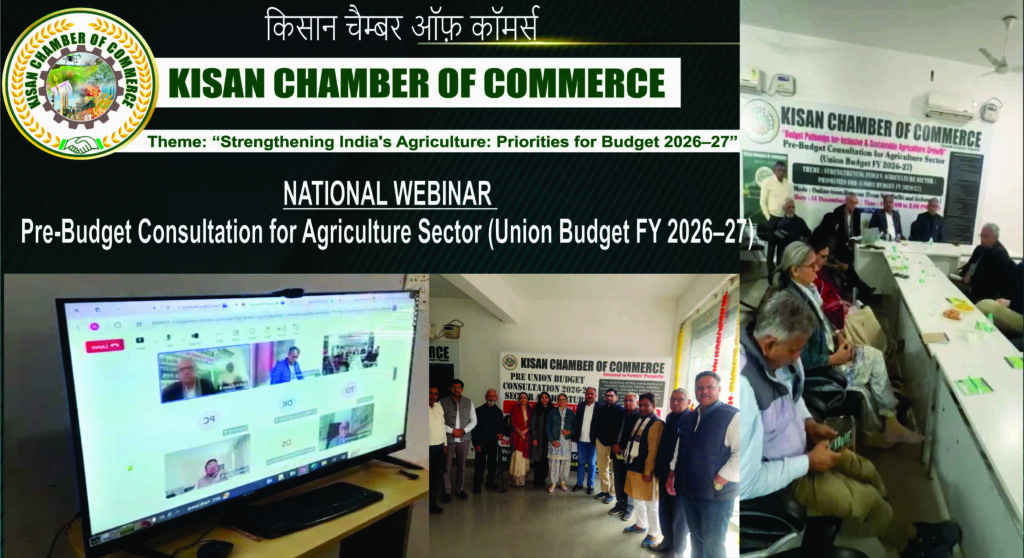
National Webinar on Pre-Budget Consultation (FY 2026–27) Agriculture Sector
Organised by: Kisan Chamber of Commerce Date: 14 December 2025 Time : 11:00AM to 2:00PM
Mode: Virtual (National Webinar)
Venue (Host Secretariat): Gohana, District Sonepat, Haryana
Background and Objective
The Kisan Chamber of Commerce convened a National Webinar on 14 December 2025 as part of its consultative process for the Union Budget FY 2026–27. The objective of the webinar was to gather evidence-based inputs, sectoral priorities, and actionable recommendations from farmers’ representatives, agricultural experts, economists, academicians, agri-entrepreneurs, cooperatives, and allied stakeholders to strengthen policy formulation for the agriculture and allied sectors.
Program Inaugurated By – Justice Pritmpal, Former Judge Pb&Hr High Court, Chandigarh
Presided By – Dr. Gurbachan Singh, Former Agriculture Commissioner
Coordination By- Sh. Jitender Mor, President Kisan Chamber of Commerce
Inaugural Session
The webinar commenced with a formal welcome by the General Secretary, Kisan Chamber of Commerce, who outlined the significance of pre-budget consultations and reaffirmed the Chamber’s commitment to inclusive, farmer-centric policy advocacy.
Key observations during the inaugural session included:
The need for predictable income support and risk mitigation for farmers.
Strengthening agri-market reforms with farmer safeguards.
Accelerated adoption of climate-resilient agriculture.
Technical and Consultative Deliberations
Government of India for due consideration agriculture sector in the Union Budget 2026–27.
Key Deliberations and Expert Views
Justice Pritampal, Former Judge Pb & Hr High Court Chandigarh, Former Lokayukat, Haryana
Rural youth play a crucial role in the future of agriculture; they act as agents of change by adopting new technologies and revitalizing food systems. However, they often face low wages, lack of resources (loans, land), and negative perceptions, leading to migration toward urban areas. To keep them engaged, programs focus on providing training in modern agribusiness, offering grants, connecting them to markets, promoting group farming and entrepreneurship (such as mushroom cultivation or composting), and transforming the image of agriculture into a profitable, high-tech business, which is done through extension services and media.
Challenges for Rural Youth in Agriculture–
a) Low Profitability & Income: Farming seen as subsistence, not a viable business.
b) Resource Scarcity: Difficulty accessing credit, land, and modern tools.
c) Negative Perception: Agriculture viewed as “old-school,” laborious, and less prestigious than urban jobs.
d) Lack of Skills: Need for updated knowledge in modern techniques and management.
e) Rural-Urban Migration: Youth leave for perceived better opportunities elsewhere, impacting food security.
By addressing these challenges and taking advantage of new opportunities in the Union Budget 2026-27, rural youth can transform agriculture into a dynamic, profitable and sustainable sector for the future.
2. Dr. Gurbachan Singh, Former Agriculture Commissioner, Chairman ASRB, emphasized:
Location-specific Organic, Natural and Integrated Agriculture & Livestock Farming
Efficient water management
Crop diversification
Transition from flat planting to furrow planting
Promotion of DSR (Direct Seeded Rice)
Participatory agricultural research
Climate change challenges and technology transfer
Engagement of ex-servicemen in farm machinery operations and rural electricity generation
3. Sh. Jitender Mor, President, Kisan Chamber of Commerce
The objective of the webinar was to deliberate on key challenges faced by Indian agriculture and to compile constructive, ground-level suggestions for inclusion in the Union Budget 2026–27. Discussions focused on farmers’ income enhancement, MSP reforms, crop diversification, irrigation and water management, agri-infrastructure, credit accessibility, crop insurance, input cost rationalization, climate-resilient agriculture, and promotion of agri-based MSMEs and startups. He said that the government should ensure that suggestions and advice are taken from the Farmers’ Chamber from time to time, just like the industrial chambers. Primarily, the participation of the Farmers’ Chamber of Commerce should be ensured in processes such as the country’s annual budget. The suggestions and advice provided by the chamber have been taken after consultations and in-depth discussions with economic experts, scientists, policymakers, agricultural industries, agricultural universities, leading farmers, and various stakeholders.
4. Dr. Balraj Singh, Former Vice Chancellor & Former Director ICAR, highlighted:
Protected cultivation and integrated farming approaches
Inadequate increase in research funding over the last 10 years
Use of fertilizers, nanotechnology and drone technology, along with their limitations
Issues of pollen shedding, climate change and human health
Gluten content, water consumption per kg yield and glycemic index of wheat, paddy, barley and bajra. Rancidity in bajra
Need for stability in pulse production
Low production of edible oils; replacement of mustard with sunflower
Importance of water harvesting
5. Sh. Harbir Singh, Editor-in-Chief, Rural-Voice, focused on:
Past and present budget allocations for agriculture
Several crop missions (pulses, cotton, etc.) announced but not effectively implemented
Absence of a National Agriculture Policy
MSP growth remaining below inflation
Non-sharing of pre-budget consultation outcomes with farmers
GDP interpretation through gross value minus taxes and production
Need for periodic review of multiple schemes
Issues with MFMB portal, where actual landowners do not receive J-Forms with their photographs
Suggestions on the proposed Seed Bill, which have presently been halted
6. Dr. Premchand, Member Commission for Agricultural Costs & Prices, emphasized:
Mandatory seed treatment to enhance crop productivity
Lower soybean productivity in India compared to the USA
Need for location-specific trials under AICRP
Soil test-based nutrient application
Agroforestry, livestock fodder development and deep irrigation practices
7. Dr. Rajbir Solanki, Former Vice Chancellor, stressed:
Importance of marketing skills for farmers
Self-grading based on moisture content
Packaging and branding of farm produce
Identifying suitable marketing systems
Promoting entrepreneurship among farmers
Cost-benefit analysis with focus on: How to produce? What to sell? How to sell?
8. Dr. Mamta Jain, Group Eitor & ECO Krishi Jgran –Rural Migration is fast becoming a matter of grave concern. COVID has taught us that the world can stop but Agriculture cannot… Every human being needs two meals a day, irrespective of his rank or profession. Hence it becomes our responsibility to take immediate steps to curb this catastrophe. The impending budget seriously needs to consider adding glamour to Rural India. With the smart phone revolution, every rural youth is now aware of the urban glitz… without understanding the challenges that accompany it. So NATION BUILDING needs to start with investing in making our villages attractive with Rural Entrepreneurship, hand holding FPOs and Farmers with food processing infrastructure in villages for better revenue of agro products, empowering rural women with skills and revenue models, recreation facilities and extensively promoting Rural Tourism.
9. Dr. J. C. Dagar ADG, ICAR focused on:
Inclusion of biomass and carbon credit mechanisms in agricultural policy
Sensitization on waterlogging
Promotion of dairy-based products
Inclusion of cold storage infrastructure
10. Dr. Deepak Jain, DGFII, highlighted:
Integration of technology in farming practices
Promotion of agri-entrepreneurship
Strengthening financial delivery systems in agriculture
Observation of nearly 40% crop losses
Lack of value addition
Adoption of hydroponic technologies to enhance farmer income
Implementation of 2–3 result-oriented monitoring missions
Constitution of a Group of Ministers with shared insights
11. Dr. Bhim Singh Dahiya, Former Director (Research), emphasized:
Need for a comprehensive water management and finance policy
Failure of Soil Health Cards to adequately address micronutrient deficiencies
Requirement of block-level planning
Formulation of economically viable policies
Development of effective market chains
Reduction of wastage
Yield variation in mustard (16 q/ha in Rewari vs. 8–9 q/ha elsewhere)
Proposal for crop holiday where necessary.
12. Dr. Ranjit Singh, Economist & HOD, suggested:
Budget discussions should be theme-wise with head-wise fund allocation
While speakers identified problems and solutions, specific financial allocations were missing
Agriculture budget should be increased to 10%
Reference to the first Agricultural Census (1971)
Shared percentage-based figures related to agriculture budget allocation
13. Prof. P S Panwar 1. Income enhancement must be driven by diversification, value addition, and strong risk management tools.
2. Market reforms should focus on integrated digital platforms, strengthened APMC systems, and empowering FPOs.
3. Agri-startups need targeted budgetary support—innovation funding, incubation, and rural tech adoption.
4. MSP reforms should ensure wider procurement coverage, transparency, and farmer-friendly mechanisms.
5. Agricultural trade strategy must build competitiveness and stability in prices.
6. Village-level post-harvest infrastructure must be prioritized for immediate returns.
7. Integrated logistics corridors and digital transport systems are essential to scale market access.
8. Micro-irrigation and water governance reforms can significantly reduce production risk.
9. SHGs need enterprise-oriented infrastructure, branding support, and digital linkages.
10. Digital agriculture should be made accessible and affordable, especially for small farmers.
14. Dr. Debesh Roy, NABARD, Institute for Pioneering Insightful Research Pvt. Ltd. (InsPIRE)
Highlighted budgetary components related to:
Agricultural credit
Post-harvest infrastructure
SHGs and FPOs
Agri-startups and innovation
Small credit size issues
Climate-related challenges
15. Dr. Samar Singh, Former Vice Chancellor, emphasized:
Budgetary support for ABIC Centres
Infrastructure for diversification
Linking MGNREGA with agricultural activities
Focus on women farmers
16. Dr. Deepak Dhattarwal DDH, IHDC, Hodal 1. Inclusion of Machines like sub-soiler/ Chisler and Industrial RO for subsidy for increase water absorption in soil/ ground water.
2. Earmarking the funds for a separate Drainage system for flooded water from regular water logged area by laying Pipelines for fresh water within existing canals and the same infrastructures of canals may be used for drain. This will ensure Human health as well as same water of canal is used for drinking purpose.
3. Earmarking the funds for essentially laying of sub surface drainage system in identified regular/annual water logged agricultural land.
4. Earmarking the funds for Establishment of underground water de-salinization plant which separate the salts from the brackish water and separated salts may be used in industrial usage.
17. Dr. Sushant Roy Burdwan Emphasis on conservation of Rain water on the surface land by digging and excavation of big ponds and water bodies, instead of lifting of underground water for agriculture. Massive use of underground water causes—
Water intoxication with Arsenic, Fluoride etc. along with scarcity of safe drinking water and causes different diseases.
Underground water acts as a pillar / buffer, to support the surface.
Excessive lifting of underground water create a vacuum and responsible for Earthquake , Landslide etc.
Give more importance to use and cultivate Indian traditional high yielding seeds instead of GEMS.
Key Recommendations Emerged
After detailed deliberations, the following broad recommendations were unanimously emphasised:
Enhanced Budget Allocation for agriculture and allied sectors with a focus on small and marginal farmers.
Strengthening MSP and Procurement systems with timely payments.
Expansion of Crop Insurance coverage and faster claim settlements.
Focused Support to FPOs for aggregation, processing, and market access.
Investment in Irrigation and Water Management to address climate variability.
Promotion of Value Addition and Agro-Processing through fiscal incentives.
Digital and Extension Services to ensure last-mile delivery of advisories and schemes.
Outcome and Follow-up Action
Many more recommendations are coming from experts, after this it was decided that: The Kisan Chamber of Commerce shall compile all recommendations and prepare a consolidated Pre-Budget Memorandum. The memorandum will be submitted to the Ministry of Finance, Ministry of Agriculture & Farmers’ Welfare, and other relevant authorities for consideration in the Union Budget FY26–27.Stakeholders will be kept informed about subsequent advocacy and policy engagement.