
expert

Pre-Budget 2026-27 Discussion: Strengthening Indian Agriculture for Inclusive Growth

Pre-Budget 2026-27 Discussion: Strengthening Indian Agriculture for Inclusive Growth Kisan serves as the backbone of a country, anchoring its economy, food security, and societal well-being. Their deep-rooted connection to the land and traditions enriches the cultural fabric of the nation, reflecting a heritage passed down through generations. It is extremely important to acknowledge the vital role of kisans, as they embody the resilience, ingenuity, and dedication required for the country’s progress and prosperity. Promoting agriculture means investing in the foundation on which the nation’s success and resilience rests. A New Vision for Rural India; India stands at the threshold of a historic transformation,  With the economy racing toward the $5 trillion mark, agriculture—long seen as a traditional livelihood—must now be reimagined as a modern, high-value, export-oriented enterprise. At the heart of this change is agriculture commerce: the dynamic flow of farm produce, technology, investment, and knowledge that can make rural India the engine of national growth. The Kisan Chamber of Commerce envisions a future where every Indian farmer is not just a producer, but a competitive market player—directly connected to domestic consumers, global buyers, and emerging agri-industries. As India prepares for the Union Budget 2026-27, the agriculture sector stands at a critical juncture. Representing nearly half of the rural workforce and contributing substantially to national food security and GDP, agriculture is central to sustainable economic growth and farmer welfare. Pre-budget consultations involving farmers’ associations, agricultural economists, industry stakeholders, and policymakers have formed the backbone of recommendations feeding into the budget formulation process. Goals for the Agriculture Budget; The overarching aim for FY 2026-27 is to enhance farmer incomes, resilience, and productivity while addressing structural impediments that limit the sector’s performance. Stakeholders have emphasized: Sustainable Income Support & Risk Management: Strengthening market interventions like MSP coverage and crop insurance to protect farmer incomes amid price volatility. Affordable Inputs & Credit Access: Improved access to cheaper credit, input subsidies, and financial services to reduce cost burdens and increase investments in farm activities. Infrastructure & Value Chains: Investments in storage, cold chains, transport networks, and modern rural infrastructure to reduce post-harvest losses and improve market access. Farmer Producer Organisation (FPO) Empowerment: Enhancing capacity, market linkage, and financial robustness of FPOs to unlock economies of scale for small and marginal farmers. Climate Resilience & R&D: Boosting climate-resilient agriculture through targeted funding for agricultural research, drought-tolerant seeds, water-use efficiency, and risk mitigation tools. Key Stakeholder Expectations; Farmers & Farmer Groups Farmers’ representatives and grassroots chambers have articulated several priority demands: Cheaper Long-Term Credit: Calls for further lowering interest rates on agricultural loans — with some groups proposing rates as low as 1% — to reduce debt burdens and unlock investment in productivity-enhancing technologies. Doubling Income Support: Suggestions to enhance flagship direct benefit schemes like PM-KISAN by increasing the per-annum transfer to farmers, thereby strengthening income stability. MSP Expansion & Market Reform: Expansion of the Minimum Support Price (MSP) mechanism beyond traditional staples to include a wider basket of crops and ensure assured procurement. Tax & Regulatory Incentives: Requests for rationalization of GST and tax structures that disproportionately affect farm inputs or equipment, helping reduce production costs. Economists & Sector Experts Economic planners and subject experts participating in pre-budget forums have underlined: Agricultural Research & Innovation: Increased budgetary allocation for research institutions, digital agriculture tools, and climate-smart technologies to drive productivity and resilience in the long term. Strengthened Insurance Mechanisms: Redesign of crop insurance schemes to improve coverage, simplify claims, and account for weather-indexed risks. Digital Agri-Economy Integration: Leveraging the Agri Stack and digital platforms to improve access to credit, inputs, insurance, price signals, and data-driven decision making for farmers and FPOs. Recommendations for Budget Priorities; based on consultations and expert consensus, the following priorities emerge for FY 2026-27: Financial Support & Risk Management. Expansion of MSP & Procurement: Broaden MSP coverage to include pulses, oilseeds, and high-value crops, with robust procurement mechanisms to stabilize farmer revenues. Credit & Insurance Reforms: Enhance Kisan Credit Card (KCC) schemes with higher limits, easier collateral norms, and deeper interest subvention. Revisit crop insurance frameworks to offer meaningful protection against climate and market risks. Infrastructure & Post-Harvest Efficiency; Cold-Chain & Storage Investment: Allocate funds for modern cold storage hubs, warehouse receipt financing systems (e.g., eNWRs) to enable farmers to time sales for better prices. Market Access & Logistics: Strengthen rural logistics networks to link production centers with urban markets, lowering transaction costs and food waste. Research, Innovation & Climate Action; R&D Funding: Increase allocations to agricultural research bodies and digital innovation programs focused on climate-resilient seeds, precision farming, and sustainable practices. Water & Soil Health Initiatives: Programs supporting micro-irrigation, soil health cards, watershed development, and nutrient management to optimize input use and productivity. Institutional Strengthening; FPO Capacity Building: Support FPOs with financial incentives, training, and market facilitation to enhance bargaining power and value chain participation. Extension Services: Reinforce extension networks to deliver knowledge, technology adoption support, and risk advisory services at the grassroots level. Policy Implications; Aligning the budget with the above priorities will not only improve farmer welfare but also: Promote inclusive growth by increasing rural incomes and reducing regional disparities. Strengthen food security through diversified production and resilient supply chains. Bolster export potential by improving competitiveness in high-value agricultural segments. Enhance climate resilience, ensuring long-term sustainability of agriculture in the face of increasing environmental risks. Kisan Chamber of Commerce – The pre-budget dialogue for FY 2026-27 underscores a broad consensus: Indian agriculture requires targeted financial support, structural reforms, and innovation-led growth strategies to uplift farmer livelihoods and energize rural economies. As the Union Budget takes shape, meaningful incorporation of these insights can transform agriculture into a more resilient, profitable, and sustainable engine of India’s economic progress. In essence, pre-budget talks gather input to shape policies that address farm distress, modernize farming, and integrate farmers into value chains, aligning with national food security and income goals, as seen in recent budgets.

Pre-Budget 2026-27 Discussion: Strengthening Indian Agriculture for Inclusive Growth Read More »

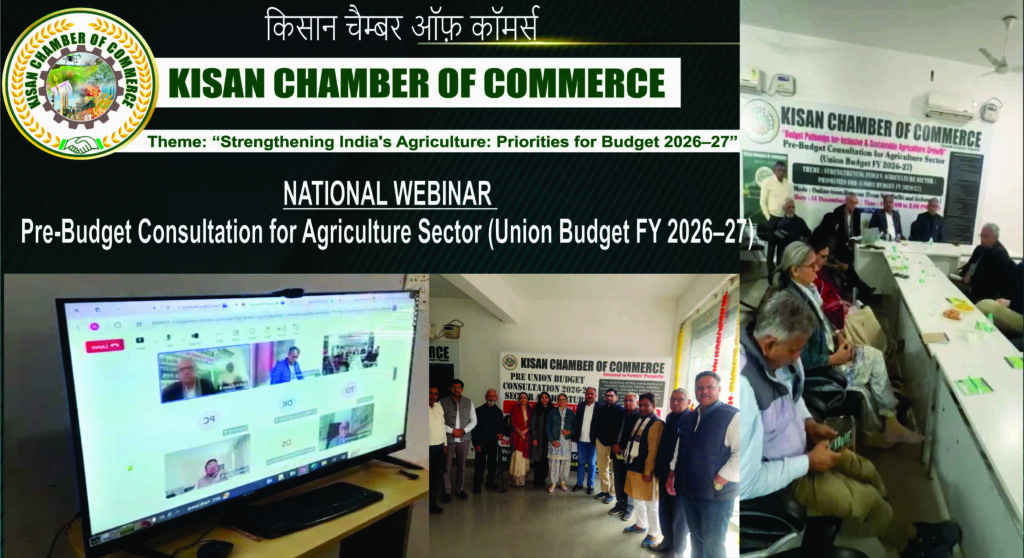
Pre-Budget Consultation for the Agriculture Sector for FY 2026–27.

National Webinar on Pre-Budget Consultation (FY 2026–27) Agriculture Sector Organised by: Kisan Chamber of Commerce Date: 14 December 2025 Time : 11:00AM to 2:00PM Mode: Virtual (National Webinar) Venue (Host Secretariat): Gohana, District Sonepat, Haryana Background and Objective The Kisan Chamber of Commerce convened a National Webinar on 14 December 2025 as part of its consultative process for the Union Budget FY 2026–27. The objective of the webinar was to gather evidence-based inputs, sectoral priorities, and actionable recommendations from farmers’ representatives, agricultural experts, economists, academicians, agri-entrepreneurs, cooperatives, and allied stakeholders to strengthen policy formulation for the agriculture and allied sectors. Program Inaugurated By – Justice Pritmpal, Former Judge Pb&Hr High Court, Chandigarh                Presided By –         Dr. Gurbachan Singh, Former Agriculture Commissioner                Coordination By-    Sh. Jitender Mor, President Kisan Chamber of Commerce Inaugural Session The webinar commenced with a formal welcome by the General Secretary, Kisan Chamber of Commerce, who outlined the significance of pre-budget consultations and reaffirmed the Chamber’s commitment to inclusive, farmer-centric policy advocacy. Key observations during the inaugural session included: The need for predictable income support and risk mitigation for farmers. Strengthening agri-market reforms with farmer safeguards. Accelerated adoption of climate-resilient agriculture. Technical and Consultative Deliberations Government of India for due consideration agriculture sector in the Union Budget 2026–27. Key Deliberations and Expert Views Justice Pritampal, Former Judge Pb & Hr High Court Chandigarh, Former Lokayukat, Haryana Rural youth play a crucial role in the future of agriculture; they act as agents of change by adopting new technologies and revitalizing food systems. However, they often face low wages, lack of resources (loans, land), and negative perceptions, leading to migration toward urban areas. To keep them engaged, programs focus on providing training in modern agribusiness, offering grants, connecting them to markets, promoting group farming and entrepreneurship (such as mushroom cultivation or composting), and transforming the image of agriculture into a profitable, high-tech business, which is done through extension services and media. Challenges for Rural Youth in Agriculture– a) Low Profitability & Income: Farming seen as subsistence, not a viable business. b) Resource Scarcity: Difficulty accessing credit, land, and modern tools. c) Negative Perception: Agriculture viewed as “old-school,” laborious, and less prestigious than urban jobs. d) Lack of Skills: Need for updated knowledge in modern techniques and management. e) Rural-Urban Migration: Youth leave for perceived better opportunities elsewhere, impacting food security. By addressing these challenges and taking advantage of new opportunities in the Union Budget 2026-27, rural youth can transform agriculture into a dynamic, profitable and sustainable sector for the future. 2. Dr. Gurbachan Singh, Former Agriculture Commissioner, Chairman ASRB, emphasized: Location-specific Organic, Natural and Integrated Agriculture & Livestock Farming Efficient water management Crop diversification Transition from flat planting to furrow planting Promotion of DSR (Direct Seeded Rice) Participatory agricultural research Climate change challenges and technology transfer Engagement of ex-servicemen in farm machinery operations and rural electricity generation 3. Sh. Jitender Mor, President, Kisan Chamber of Commerce The objective of the webinar was to deliberate on key challenges faced by Indian agriculture and to compile constructive, ground-level suggestions for inclusion in the Union Budget 2026–27. Discussions focused on farmers’ income enhancement, MSP reforms, crop diversification, irrigation and water management, agri-infrastructure, credit accessibility, crop insurance, input cost rationalization, climate-resilient agriculture, and promotion of agri-based MSMEs and startups. He said that the government should ensure that suggestions and advice are taken from the Farmers’ Chamber from time to time, just like the industrial chambers. Primarily, the participation of the Farmers’ Chamber of Commerce should be ensured in processes such as the country’s annual budget. The suggestions and advice provided by the chamber have been taken after consultations and in-depth discussions with economic experts, scientists, policymakers, agricultural industries, agricultural universities, leading farmers, and various stakeholders. 4. Dr. Balraj Singh, Former Vice Chancellor & Former Director ICAR, highlighted: Protected cultivation and integrated farming approaches Inadequate increase in research funding over the last 10 years Use of fertilizers, nanotechnology and drone technology, along with their limitations Issues of pollen shedding, climate change and human health Gluten content, water consumption per kg yield and glycemic index of wheat, paddy, barley and bajra. Rancidity in bajra Need for stability in pulse production Low production of edible oils; replacement of mustard with sunflower Importance of water harvesting 5. Sh. Harbir Singh, Editor-in-Chief, Rural-Voice, focused on: Past and present budget allocations for agriculture Several crop missions (pulses, cotton, etc.) announced but not effectively implemented Absence of a National Agriculture Policy MSP growth remaining below inflation Non-sharing of pre-budget consultation outcomes with farmers GDP interpretation through gross value minus taxes and production Need for periodic review of multiple schemes Issues with MFMB portal, where actual landowners do not receive J-Forms with their photographs Suggestions on the proposed Seed Bill, which have presently been halted 6. Dr. Premchand, Member Commission for Agricultural Costs & Prices, emphasized: Mandatory seed treatment to enhance crop productivity Lower soybean productivity in India compared to the USA Need for location-specific trials under AICRP Soil test-based nutrient application Agroforestry, livestock fodder development and deep irrigation practices 7. Dr. Rajbir Solanki, Former Vice Chancellor, stressed: Importance of marketing skills for farmers Self-grading based on moisture content Packaging and branding of farm produce Identifying suitable marketing systems Promoting entrepreneurship among farmers Cost-benefit analysis with focus on: How to produce? What to sell? How to sell? 8. Dr. Mamta Jain, Group Eitor & ECO Krishi Jgran –Rural Migration is fast becoming a matter of grave concern. COVID has taught us that the world can stop but Agriculture cannot… Every human being needs two meals a day, irrespective of his rank or profession. Hence it becomes our responsibility to take immediate steps to curb this catastrophe. The impending budget seriously needs to consider adding glamour to Rural India. With the smart phone revolution, every rural youth is now aware of the urban glitz… without understanding the challenges that accompany it. So NATION BUILDING needs to start with investing in making our villages attractive with Rural

Pre-Budget Consultation for the Agriculture Sector for FY 2026–27. Read More »

भारतीय कृषि क्षेत्र को टैरिफ (Tarriff war) और WTO की जड़ता के बीच कठिनाइयों का सामना करना पड रहा है – किसान चैंबर ऑफ़ कॉमर्स

वीरेंदर सिवाच, अध्यक्ष, किसान चैम्बर ऑफ़ कॉमर्स भारतीय कृषि क्षेत्र को टैरिफ (Tariff war) और WTO की जड़ता के बीच कठिनाइयों का सामना करना पड रहा है – किसान चैंबर ऑफ़ कॉमर्स विश्व व्यापार संगठन की तीसवीं वर्षगांठ 26 से 29 मार्च 2026 कैमरून में है, जैसे-जैसे तारीख नजदीक आ रही है भारत का कृषि क्षेत्र दबाव में है। वर्ष 1994 का उरुग्वे दौर जिसने पहली बार कृषि को वैश्विक व्यापार नियमों में शामिल किया, लेकिन अब यह दूर की संभावना प्रतीत होता है। भारत का कृषि क्षेत्र जिस पर 50% से ज्यादा आबादी जीवन यापन के लिए निर्भर है और वित्तीय वर्ष 2024-25 में $ 48.2 बिलियन का निर्यात करता है, एक तिहरे संकट का सामना कर रहा है ; ट्रंप के जिद्दी हमले, अस्थिर जलवायु पैटर्न, और ठप पड़ी WTO प्रक्रिया। वर्ष 1991 में के दशक में जब भारत उदारीकरण के बाद वैश्विक व्यापार में धीरे-धीरे कदम रख रहा था, उरुग्वे राउंड समझौते की कृषि के क्षेत्र में एक शानदार छलांग के रूप में प्रशंसा की गई। इसने भारत जैसे विकासशील देशों को खाद्य सुरक्षा की रक्षा करने की छूट दी, जबकि अमेरिका और यूरोपीय संघ ने सब्सिडी को मजबूत किया। चीन की 2001 में एंट्री और ब्रिक्स के उभार ने संतुलन को बदल दिया, भारत और ब्राजील ने अमीर देश के विकृतियों के खिलाफ G20 में दबाव बनाया। लेकिन वैश्वीकरण की प्रतिक्रिया 1999 के सिएटल विरोध प्रदर्शन के रूप में स्पष्ट थी, और गति जल्द ही कम हो गई। 2015 का नैरोबी सौदा निर्यात सब्सिडी को समाप्त कर दिया लेकिन खाद्य निर्यात प्रतिबंधों को अनसुलझा छोड़ दिया। 2019 तक, WTO की विवाद निपटान प्रणाली तबाह हो गई जब वॉशिंगटन ने अपील मंजूरी पर रोक लगा दी।  डॉनल्ड ट्रंप की दूसरी पारी ने संकट को बढ़ा दिया। अप्रैल 2025 में घोषित उनके  लिबरेशन डे टैरिफ ने उन देशों को लक्षित किया जो व्यापार संतुलन या राजनीतिक सहमति का सामना कर रहे थे। भारत को इसका खामियांजा भुगतना पड़ा। 7 अगस्त को 25% का टैरिफ लगाया गया जो महीने के अंत तक 50% हो गया कथित रूप से यूक्रेन संघर्ष के दौरान तेल खरीदने के लिए। वाणिजय मंत्रालय भारत सरकार ने इसे गहरे खेद का विषय बताया, यह बताते हुए कि इसमें भारतीय कृषि निर्यात, जिसमें मसाले और चाय शामिल हैं, के लिए  $3.47 अरब के खतरे का जिक्र किया गया। द्विपक्षीय व्यापार वार्ताएं अमेरिका की डेयरी पहुंच की मांग और भारत के किसानों को उजागर करने के प्रतिरोध के कारण बाधित हो गई। जलवायु और खाद्य प्रणाली संकट, व्यापार झटके, जलवायु तनाव के साथ टकरा रहे हैं 2025 की मानसून ने आसमान से भयंकर वर्षा और भयंकर गर्मी लाई, जिसके कारण गेहूं और चावल प्रभावित हुए, तापमान की 1डिग्री सेल्सियस वृद्धि गेहूं की पैदावार को 6 से 10% कम कर सकती है, जिससे लगभग 60%  कृषि भूमि जोखिम में है। अनुकूलन के बिना 2050 तक चावल की उत्पादन 20% तक गिर सकती है। भारत पहले से ही चावल निर्यात प्रतिबंधों और दालों की कमी का सामना कर चुका है। तेल बीज पर निर्भरता बढ़ गई है, जहां 60% मांग आयात से पूरी होती है। जबकि आधे से अधिक किसानों ने जलवायु  प्रतिरोध बीज अपनाएं हैं अनुकूलन आसमान है और परिवर्तन की गति को पीछे छोड़ रहा है। इससे स्पष्ट है कि किसानों के विरोध फिर से शुरू हो जायेंगे, जो सभी फसलों के लिए कानूनी न्यूनतम समर्थन मूल्य (MSP) की मांग कर रहे हैं और “WTO छोड़ो” के नारे को फिर से जीवित कर रहे हैं। राजमार्गों पर अवरोध और गांव की आत्मनिर्भरता कि उस आंदोलन की गूंज है जिसने 2021 में कृषि कानूनों को पलट दिया था। बेशक सर्वेक्षण अभी भी यह दिखाता हो कि 60% जनता प्रधानमंत्री मोदी का समर्थन करती है लेकिन असंतोष अमेरिका की कृषि राजनीति को दर्शाता है जहां ट्रंप को मजबूत ग्रामीण समर्थन प्राप्त है। सरकार पीएम-किसान निधि पर निर्भर है, जो 100 मिलियन परिवारों तक पहुंचता है, लेकिन कृषि व्यापार पर सहयोग समर्थन को नरम करने से इंकार करती है। वैश्विक स्तर पर, मनोवृति कुशलता में विश्वास से बाजारों पर संदेह की और सुई मुड़ गई है। मित्रशोध नया मंत्र है जिसमें सप्लाई चैन को सहयोगियों की ओर मोड़ा जा रहा है, भारत का व्यापार घाटा जून 2025 में 18.8 बिलियन डॉलर पर पहुंच गया था, जिसमें आयत 53.9 बिलियन डॉलर और निर्यात 35.1 बिलियन डॉलर था। सोयाबीन की खरीद अमेरिका से ब्राजील की ओर स्थानांतरित हो गई है। UK और इफ्त EFTA के साथ मुक्त व्यापार समझौते से £25.5 बिलियन के कृषि प्रभाव का आश्वासन है लेकिन इस तरह की व्यवस्थाओं में रणनीतिक शर्तें और अक्षमताएं होती हैं। कृषि क्षेत्र : भारत के लिए नीति विकल्प नीति निर्माता के लिए आवश्यकता स्पष्ट हैं। व्यापार ने कल्याण और खाद्य सुरक्षा में सुधार किया है लेकिन इससे कुछ लोग निराश भी हुए हैं। पीएम-किसान जैसी योजनाएं व्यापक सुरक्षा की तुलना में बेहद निम्न हैं, जबकि बागवानी में निवेश को पोषण को संबोधित करता है बिना सीमाएं बंद किए। उर्वरक और खाद्य तेल जैसी सामग्रियों के वैश्विक मूल्य श्रृंखला विश्लेषण पुराने व्यापार मॉडलों की तुलना में अधिक उपयोगी हैं। किसान जिनका हित केंद्रित है, संगठित होते रहेंगे जबकि उपभोक्ता फैलाव में रहते हैं और “तर्कसंगत रूप से अज्ञानी” होते हैं। यह गतिशीलता प्रदर्शन को बढ़ावा देती है जो संकट को पहचान राजनीति के साथ मिलाती है, जो यूरोप में असंतोष को दर्शाती है जहां कृषि गुस्सा जनवादी पार्टियों को बढ़ावा दे रहा है। कृषि लंबे समय से व्यापार सौदों की बाधा रही है। अब चुनौती प्रणालिगत है, जो व्यापक व्यापार व्यवस्था को घेर लेती है। भारत का अनुभव- सब्सिडी, मजबूती और निष्पक्षता का संतुलन- वैश्विक नियमों को आकार देने में सबक प्रस्तुत करता है जैसे-जैसे MC14 (14वां विश्व व्यापार संगठन मंत्रीसतरीय सम्मेलन) निकट आ रहा है, प्राथमिकताएं स्पष्ट हैं: सार्वजनिक भंडारण पर सुरक्षित समाधान हासिल करना, जलवायु वित्त के लिए दबाव डालना, और किसानों की आवाज को बढ़ाना। रणनीतिक स्पष्ट के साथ भारत यह सुनिश्चित करने में मदद कर सकता है कि वैश्विक व्यापार उनके कृषि अर्थव्यवस्था के मूलभूत तत्वों को कमजोर करने के बजाय मजबूत करें। संक्षेप में, शुल्क-वृद्धि का किसानों पर कई तरह का प्रभाव पड़ सकता है, जिससे उत्पादन

भारतीय कृषि क्षेत्र को टैरिफ (Tarriff war) और WTO की जड़ता के बीच कठिनाइयों का सामना करना पड रहा है – किसान चैंबर ऑफ़ कॉमर्स Read More »

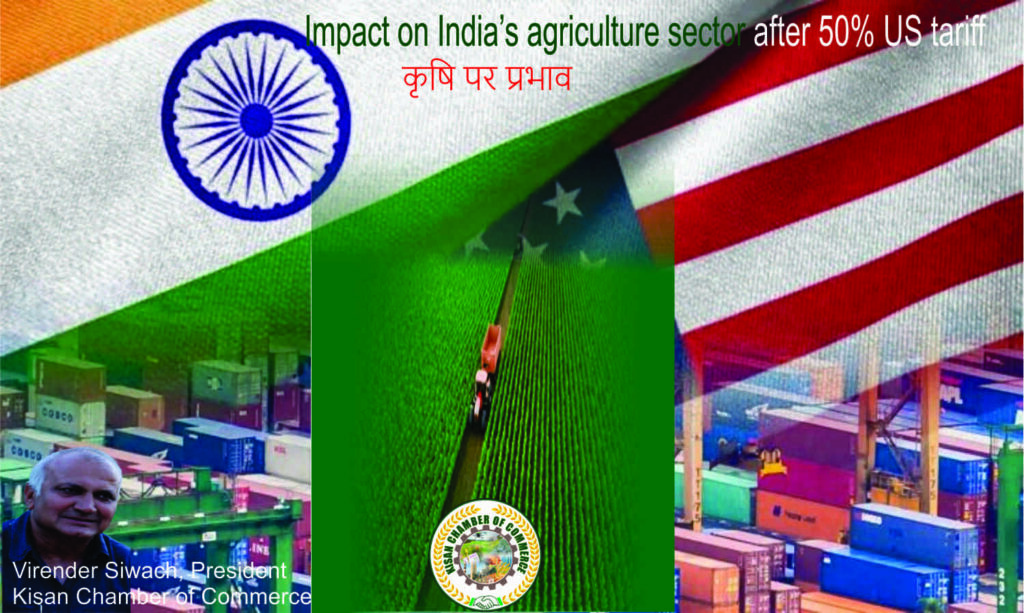
Impact on India’s agriculture sector after 50% US tariff

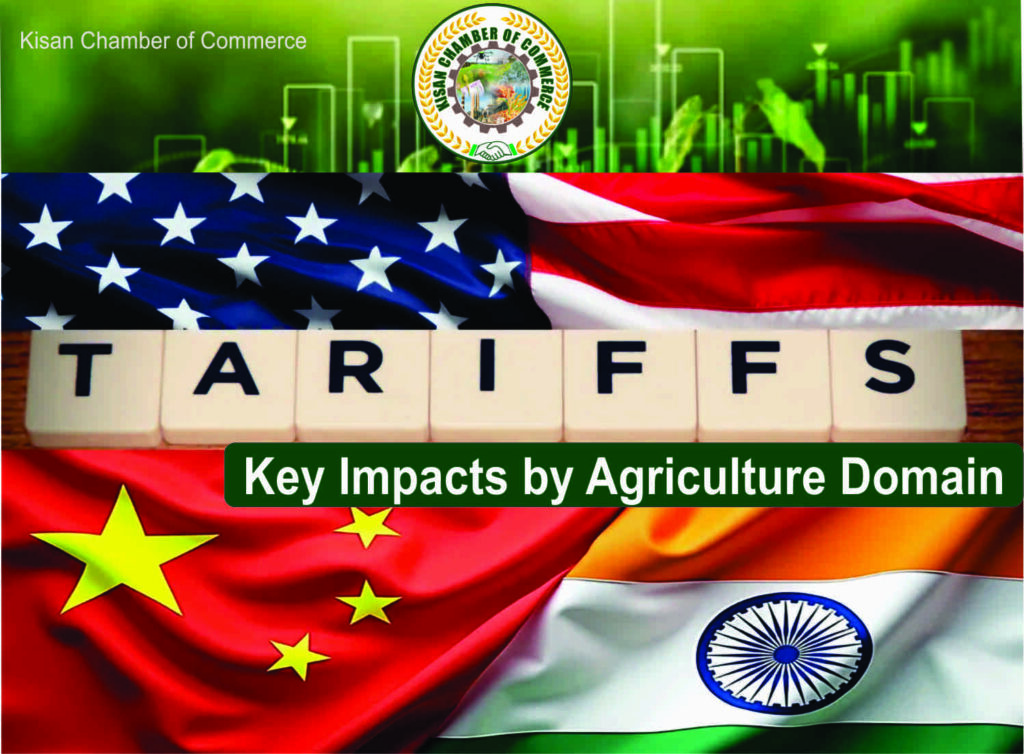
How the Tariff Came About In August 2025, the U.S. government announced a two-part tariff increase on Indian goods: a 25% reciprocal tariff followed by an additional 25% penalty tied to India’s continued purchases of Russian oil—bringing the total duty on many Indian exports to 50% These elevated tariffs became effective on August 27, 2025 Here’s a clear breakdown of how a 50% U.S. tariff could affect India’s agriculture sector, particularly in terms of exports, domestic producers, and broader economic implications: Export Impact on Indian Agri-Food Products Domestic Vulnerabilities and Farmer Distress Broader Economic Ripple Effects Summary: Key Impacts by Agriculture Domain Area Expected Impact Seafood/Processed Foods Exports likely to drop or become unviable—exporters passing costs to U.S. buyers Basmati Rice / Makhana Significant contraction in exports—loss of premium market and farmer distress Cotton Farmers Domestic price pressure from cheap imports—harms MSP-related incomes Rural Employment Potential job losses in export-linked agribusiness and processing industries Policy Response Need for export subsidies, diversification, reforms, and new market strategies Conclusion The 50% U.S. tariff (effective ~33.6%) has stark implications for India’s agriculture and food processing sectors: Here’s an in-depth style overview on how a 50% U.S. tariff is affecting India’s agriculture sector, drawing from recent data and analysis by industry bodies, think tanks, and news agencies.

Impact on India’s agriculture sector after 50% US tariff Read More »

Farmers’ Issues and National Security Genesis of farmer’ agitation

Farm Income return is going down & cost of production is going up. After independence the country was rated as a failed state which could survive on international food aid. The American Authors —wrote books on food situation in the country entitled houseful. We were living from ship to mouth. Farmer’s of Punjab including present Haryana took up the challenge and sacrificed all their resources (land, water, animal health & their own health to produce enough food for the nation. The political leadership didn’t bother to meet their expectations for the sacrifices they have made, they feel isolated, ignored & frustrated. Presently farmers are fighting for their survival, respectful place in the society. It is in their DNA to sacrifice & die for the nation, people should read history – during 1962 China attacked us, we were very poor and not able to provide suitable winter clothing to our soldiers. The then Prime Minister Pt. Jawaharlal Nehru created National Defence Fund (NDF) and asked the people to donate. The total contribution was Rs 8 Cr. out of which 46% was from Punjab, gold donation (jewelry & coin) was 262 kg out of which 252 was from Punjab. People do debate that farmers should be taxed,- he already pays taxes on farm machinery then diesel/ petrol, electricity, all agri inputs & consumable articles. — increase their income so that it qualifies for tax. Who pays tax Industry & Employees? Industries fix the price of their products but in case of farmers situation is different that’s why they demand a guarantee for the price of their product as per recommendation of Late. Dr. Swaminathan commission (C2+ 50%) on the other hand the employees get benefits from the government in the form of medical allowance, children education, annual increment, ADA, more than 150 days holidays in a year and salary is ensured irrespective of any natural calamity. There is not even a single day break for the farmer and he works under the open sky. At present food is not only for food security of the people but it is an issue of national security because there is turmoil in the world food producing countries.  The food deficit will lead to chaos & instability in the country. Irritants of the farmers:                                                                                                                                                             Why MSP should be a law – For ensuring better & stable returns for the farm produce. The production potential of the soil has gone down drastically (organic carbon less than 0.3% which is like hemoglobin in the human blood). The quality of agri inputs is a serious issue and the government is failing in its responsibilities to sincerely implement the various agri input acts like Seed Act, Fertilizer Act and Insecticide Act which has resulted in building resistance among pests and pathogens. The regulatory role is of the government where the government is a total failure; spurious agri inputs not only reduce the agriculture produce but also causes serious environmental issues. Inputs should be provided in required quantity, assured quality & timely availability which is again a question mark on the part of government as the farmers have to stand in a queue  overnight for one bag of urea/DAP which is a recurring feature. Stray cattle (blue bulls wrongly called as cow), wild pigs etc are a big threat even for diversification. Availability and timing of electricity supply to tube wells – sharp fluctuations leading damage of motors a big disruption in the routine activities of the farmers. Why farmers should work during night for irrigation. The timing of electricity supply has to be regularized specifically in the afternoon/evening for efficient water utilization. Policy Issue                                                                                                                                                                                  There is no agricultural policy in the country – What to produce, where to produce & how much to produce this should be in consonance with nature (soil, water & local climate-temp. , humidity, biological diversity etc).our focus is on to produce more with least concern of environment . Which crop, which animal, which agri forestry – horticulture trees, don’t grow everything everywhere, and grow what is economical as determined by climate which is very critical for sustainable growth? Diversification                                                                                                                                                                     In culture, religion, language and economics and agriculture is the basis of survival of a society. Diversity in agriculture is essential for health of the soil, people, animals and Nation. Check the losses due to climate change, disease epidemics, and diverse crops also essential for healthy, safe and clean food to the people of the nation. For any technology being even technically feasible and economically viable will find adoption when there is favorable public policies example-green revolution. The fall out of green is revolution environmental degradation of soil, water etc. Presently eating poison, drinking poison, breathing poison and sleeping with poison. The kind of food one eats affects his thought process, there was need for mid course correction during eighties when we became self sufficient in food but country’s leadership fail to do it. Inspite of regular hammering by agricultural scientist, who also emphasized policy change on Production planning, processing, value addition and marketing. There is a feb of natural farming/organic farming but no Policy –reduction in Production but there is no mechanism for compensation hence it will not find a acceptance on large scale. Take lesson from Srilanka, aim should be to produce chemical free foods. The indiscriminate use of the chemicals in farming has dames the health of people, animals and Nation as a whole – for example celiac disease, gluten allergy, diabetes (we are world capital of diabetes). Stunting growth of children (less than 3 yrs 36% of the world). Primarily due to eating of (wheat & rice) this supports diversification. PM Samman Nidhi                                                                                                  This is a cruel joke with the farmers (equal to 1 day wage in a month – twelve working days in a year) Present crop insurance policy is lop sided, heavily loaded in favor of insurance companies. The criteria compensation should be on ‘khasra’ basis example hail storm/locust. Attack, loss estimation unit area has to be different for

Farmers’ Issues and National Security Genesis of farmer’ agitation Read More »

Scroll to Top